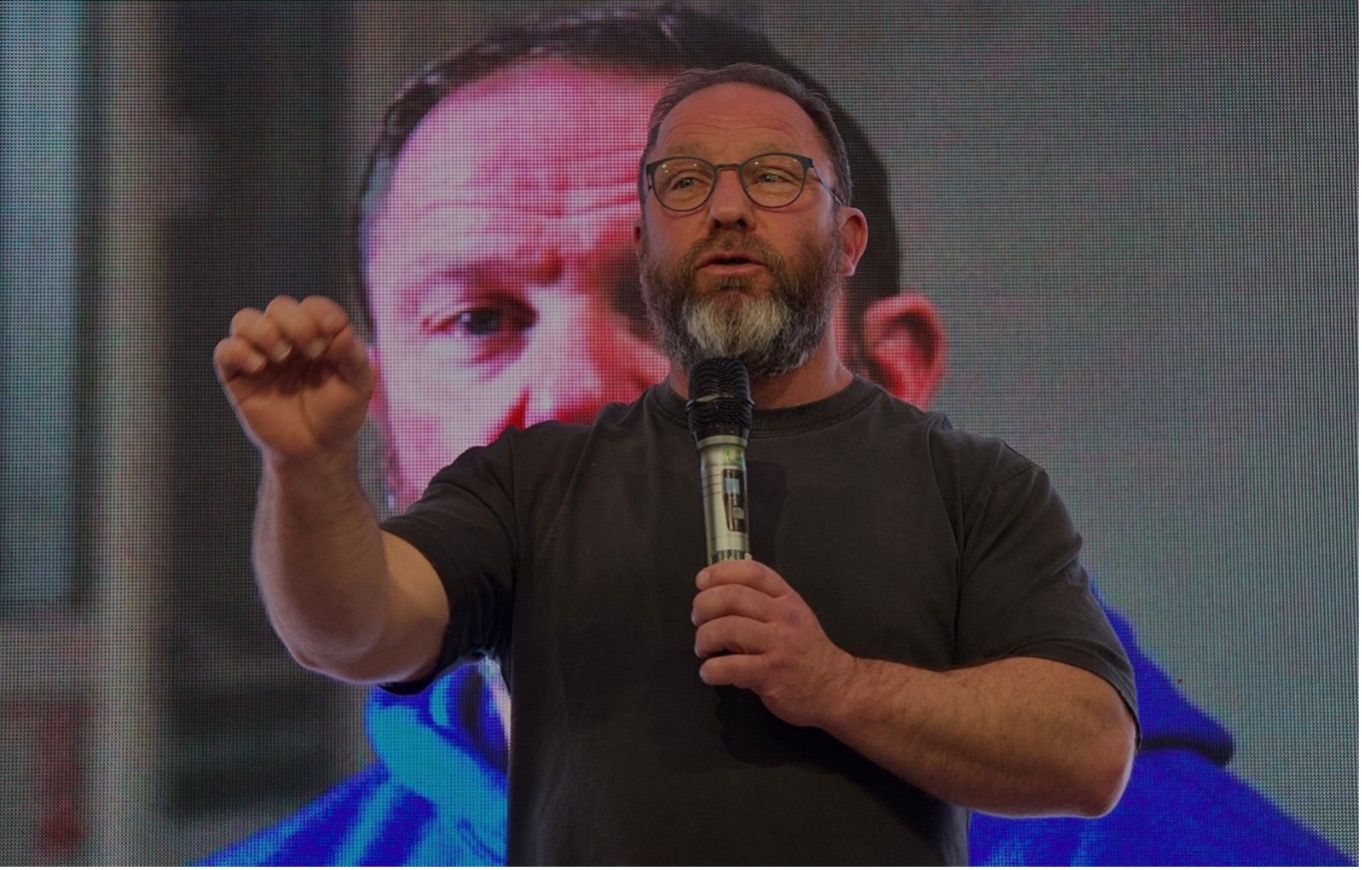
I travelled to meet Michael Dowie with a few preconceptions. His YouTube videos present him as a serious man, thoughtful, disciplined and not given to smiles or laughter. I wondered whether that seriousness would carry over into everyday conversation. It did, to a degree, but what surprised me was how relaxed, approachable and personable he was away from the camera. I was meeting him in Luton, the town where he lives and where he grew up, and within minutes many of my assumptions began to fall away.
Michael is no ordinary Muslim revert. Over the years he has built a significant online following, where his direct style and willingness to engage with difficult subjects have attracted both supporters and critics. Rather than avoiding controversy, he has often stepped into debates that many others would rather leave alone. He has challenged anti-Muslim narratives, spoken out against the far right and appeared on some of the country's most popular online platforms. These appearances have included a podcast with Liam Tuffs, a broadcaster whose channel frequently features criticism of Islam, immigration and multiculturalism. Michael also took part in a 2026 Oxford Union debate on the motion, This House Believes That the West Is Right to Be Suspicious of Islam, where he opposed speakers including Tommy Robinson and Laurence Fox.
Michael reverted to Islam at the age of twenty-six, almost thirty years ago, at a time when the internet was not yet part of everyday life. Raised in a working-class family in Luton, he was the only child of his parents' marriage, although he had half-siblings from both his mother's and father's earlier relationships. His family were largely accepting of his reversion and, in an interesting twist, his father embraced Islam himself four years before he died. By his mid-twenties, Michael was working as a builder and preparing to become a father. On the surface, life seemed to be falling into place. Yet he was troubled by a persistent feeling that something was missing. Although he had not been brought up in a religious household, he had always believed in God. He recalled visiting a grassy hill near his home in Luton late at night to pray alone. On one occasion, he looked up towards the sky and said out loud to God: "I'm going to come and find You."
That moment marked the beginning of a spiritual search. Michael began exploring different faiths and traditions, looking into Christianity, the Jehovah's Witnesses, Hinduism and Buddhism before eventually turning his attention to Islam. He wanted to learn more and decided to visit a mosque. Knowing that Muslims did not drink alcohol, he abstained for three days beforehand. He had no idea that it was Ramadan or that the mosque would be packed with worshippers when he arrived. He was immediately struck by the atmosphere, the prayers, the sense of brotherhood and the warmth of the welcome he received. The energy of those around him made a deep impression on him, and the experience felt instantly right. Within a short time of arriving, he was asking, "How do I become a Muslim?" He then took the Shahada and was welcomed with hugs from rows of worshippers. Having entered the mosque as a visitor, he left the same day as a Muslim.
The decision brought certainty, but it also brought challenges. Michael knew Islam would require changes in his life and there were times when he wondered how he would fit in. Looking back, he said the question was never simply what he was changing from, but who he was changing into. His girlfriend at the time also took the Shahada, but her commitment to Islam did not continue and the relationship eventually came to an end, with Michael later marrying someone else. Giving up pork and alcohol posed little difficulty. Circumcision, however, was another matter. Looking back on the experience, Michael recalled the experience with a laugh, describing it as "not much fun."
There were moments when he felt caught between cultures. As an English revert, he sometimes sensed a degree of tension in Muslim communities, not through hostility but through uncertainty about how to relate to someone whose background differed from their own. On occasions, he felt that some people wanted to make him more like them rather than allowing him to find his own way as a Muslim. At one point he was even encouraged to learn Urdu but resisted such expectations. Michael has always been a fiercely independent man and reached a point where he found himself questioning whether he was losing sight of his own identity and developing a form of impostor syndrome.
He did not want to become a version of himself that he no longer recognised. Michael believes this has historically been a challenge for many reverts, although he feels support and aftercare are generally better today than when he embraced Islam nearly three decades ago. Even so, he noted that a significant proportion of reverts leave the faith within their first few years. His own journey was different and rather than trying to become somebody else, he gradually found a way of being both authentically English and authentically Muslim.
Islam quickly became the organising principle of Michael's life. Over the following decades he built a family, remained in the building trade and developed a growing online profile, while his faith continued to deepen. During our discussion he returned repeatedly to what he sees as an imbalance within parts of contemporary Islam. He felt that far too much emphasis is placed on punishment and far too little on the mercy of Allah. He was critical of some older muftis and mullahs who arrived from the Indian subcontinent and never fully adapted to life in Britain, adding that community building had too often been neglected in favour of rigid instruction.
Michael said he feels that weekly khutbahs should leave people inspired for the week ahead rather than worrying about God's wrath if they do this or that. Any sermon that lacks dawah, an invitation towards Islam, quickly becomes irrelevant, unengaging and uninspiring. Speaking about the Prophet Muhammad (peace be upon him), Michael said his life demonstrated a remarkable balance in all things. He described a man devoted to God yet fully engaged with family life and everyday people, someone who always seemed to get everything right while never losing sight of the ordinary individual. Michael said he often reflects on this and finds it difficult to believe that such a person could have been anything other than chosen by God.
Michael takes masculinity seriously and has frequently spoken on his online platforms about what he sees as the emasculation of men in modern society. As our meeting approached, I wondered whether I would measure up. I have no impressive physique, no tattoos, am clean-shaven and enjoy wearing nice scents. I even briefly questioned whether my manspread was wide enough. After all, I was about to meet a man's man. As it turned out, I needn't have worried. Michael does indeed go to the gym several times a week and is clearly in good physical condition, although I couldn't help noticing that he is not a particularly tall man. When I asked him what he believed made a man masculine, he spoke less about appearance and more about character. He said he admired what he called "straight goers", people who stand by their principles and are prepared to live by them. He believed that a good man provides for his family, protects those around him, serves his community and takes responsibility for his actions. By contrast, he was critical of men who shirk responsibility and are content to let others carry the burden for them. Good deeds and good example matter greatly to him. Life offers only one opportunity, he said, and people will ultimately be judged by how they have lived. Men should have a mission, a sense of purpose and something larger than themselves to strive towards. Michael has made it his mission to build bridges between Muslims and non-Muslims and to make Islam relatable to as many people as possible.
Moving our discussion on, I steered the conversation towards women and Islam and asked Michael why he thought so many people in the West believe Muslim women are poorly treated. I read out a series of controversial statements that had been attributed to a preacher at the Hackney Islamic Centre, including reported remarks that husbands could "lightly hit" wives who refused sex or were considered disobedient, and that women should not leave the home without their husband's permission. Michael had not heard the reports concerning the preacher but said that his understanding of Sharia was that it is a system of law based on justice, mercy and common sense. He felt that many discussions about Sharia fail to take account of the wider context in which particular rulings are understood. While not commenting directly on reports he had not seen for himself, Michael said that individual statements should be considered in their full context before conclusions are reached. He argued that rulings within Sharia are subject to strict conditions and should not be viewed in isolation. Nevertheless, he was clear that Sharia is not the law of the United Kingdom and that Muslims are obliged to obey the laws of the country in which they live. As such, he said that any man who commits domestic violence against his wife should be reported to the police and dealt with through the legal system.
Our discussion then turned to the hijab and burka. Michael believes that many people in Western societies struggle to accept that some Muslim women choose to wear religious dress of their own free will. Too often, he said, the hijab is automatically viewed as a symbol of oppression, while little attention is given to the women who insist they wear it by choice and do not feel oppressed in the slightest. I challenged Michael on whether women raised in Muslim families are conditioned from an early age to accept expectations around modesty, covering and relationships between men and women, just as people brought up in the West absorb a very different set of values and assumptions. He responded by pointing to the number of women reverting to Islam, noting that various studies have found women account for over 60 per cent of reverts in the United Kingdom, while reversion patterns in the United States are more mixed. If Islam is as oppressive to women as critics suggest, he asked, why are so many women choosing to embrace it of their own accord?
When I raised the subject of Afghanistan and the treatment of women there, including their exclusion from education and the wider restrictions placed upon them, Michael argued that such policies stemmed from extreme cultural influences rather than Islam itself. However, he was under no illusions about the situation in the country and was highly critical of developments there. He said he did not feel any obligation as a Muslim to defend or justify what was happening in Afghanistan, adding that most Muslims in the West would agree that the Taliban are not following Islam as it should be practised. Indeed, he joked darkly that, were he to visit Afghanistan, even as a British Muslim, there was every chance he would return home in a coffin.
In recent interviews, former Prime Minister Liz Truss has described Islamism as the greatest threat facing Britain, arguing that issues such as the economy, housing and healthcare can be reversed, whereas what she termed the "Islamification" of the country would be far harder to undo. She linked these concerns to immigration policies, chain migration and the growth of what she described as Muslim enclaves within some communities. Michael is not an admirer of Liz Truss and dismissed her remarks as alarmist and divisive. He said it was obvious to him that some former politicians make such comments to remain relevant, knowing there is a section of society receptive to what he described as this type of "red meat" rhetoric. Michael categorically rejected the idea that Islam poses a threat to the West, arguing instead that it is perceived as a threat by many people who do not properly understand it, with much of the hostility surrounding the religion stemming from ignorance, misunderstanding and a lack of meaningful contact between communities.
Asked what he regarded as the biggest challenges facing Islam in Britain today, Michael pointed to the far right, sections of what he described as the neo-liberal left and social media, which he believes amplifies division, fuels tension and encourages Islamophobic narratives. He argued that the far right seeks to drive communities apart and said this made it even more important for Muslims to continue contributing positively to society and setting a good example through their conduct. Michael also claimed that much of the funding and support behind far-right movements originates from outside the UK rather than from grassroots domestic support. He was sceptical of claims that the far right is motivated by a desire to restore Christianity in Britain, arguing that many of its supporters are largely secular and have little real interest in religion. Rather than promoting traditional Christianity, he believed that some had embraced a strand of American-style evangelical politics that sits uneasily within the British context. Michael also spoke about the importance of protecting vulnerable people from exploitation. As an example, he said he had advised Liam Tuffs on several occasions not to interview Muhammad Saifullah, an Islamic content creator and online commentator known for his hard-line views on Islam and Sharia law, because of his history of mental health difficulties. Michael believes public platforms should exercise caution when featuring vulnerable individuals, particularly where there is a risk that their circumstances could be exploited for views or entertainment.
Our conversation eventually turned to Tommy Robinson. Michael's assessment was that Robinson is finished, having gone so far down the road of anti-Islam activism that there is now no obvious way back. He described him as a man trapped by the very forces he once chose to align himself with. "That's what happens when you dance with the devil," he said. "Eventually the music stops."
Michael argued that many of those who set out to discredit Islam do so by portraying it as a religion of violence, crime and extremism. Such people, he suggested, spend years convincing others to fear Muslims while building careers and reputations from the controversy that follows. They may attract large audiences and plenty of attention, but Michael believes there is always a price to pay for spending a lifetime attacking the faith of others. Michael remarked that he would not be surprised if Robinson's story ended in a similarly tragic fashion to that of Charlie Kirk. Figures who build large followings through opposition to Islam, he suggested, often generate such strong emotions among both supporters and critics that their lives can take dark and unpredictable turns. He added that when such figures eventually fall from public view, there will no doubt be people left behind to mourn them, celebrate them and perhaps even write poems about their fallen anti-Islam heroes. What mattered more to him, though, was what a person leaves behind and whether they had contributed something positive during their time on earth. Perhaps that goes some way towards explaining why Michael devotes so much of his public life to building greater understanding between Muslims and non-Muslims. He spoke proudly about the hundreds of messages he has received over the years, many from non-Muslims, thanking him for helping them better understand Islam and the people who follow it.
As our conversation drew to a close, I reflected on how different the real Michael Dowie was from the figure I had imagined before travelling to Luton. It became clear early on that he is a very honourable and principled man. Away from public life, he lives a quiet existence and enjoys nothing more than spending time with his family, including his four sons, the youngest of whom is sixteen. He enjoys going out on country walks and, apart from that, he is quite content relaxing at home watching the History Channel while sipping a non-alcoholic Guinness.
There was, however, one mystery I didn't manage to solve during our meeting, and that was exactly how many times Michael says "mate" in a single day. It is undoubtedly one of his favourite words and he uses it with such frequency that a place in the Guinness Book of Records is surely there for the taking. Like it or not, though, the word has become a core part of who he is: direct, authentic and unapologetically himself. At a time when so many people seem intent on driving communities further apart, he has chosen a different path. Whether one agrees with him or not, much of his public life has been devoted to building bridges between Muslims and non-Muslims and encouraging greater understanding between them. And, mate, there is probably something rather admirable about that!